Cognitive Behavioral Therapy (CBT) is one of the most widely used and well-researched approaches in modern therapy. But if you have been reading about it online, you have probably noticed that most explanations are either too clinical to be useful, or so simplified that they do not tell you what the therapy actually does.
Here is a clearer version.
THE CORE IDEA BEHIND COGNITIVE BEHAVIORAL THERAPY
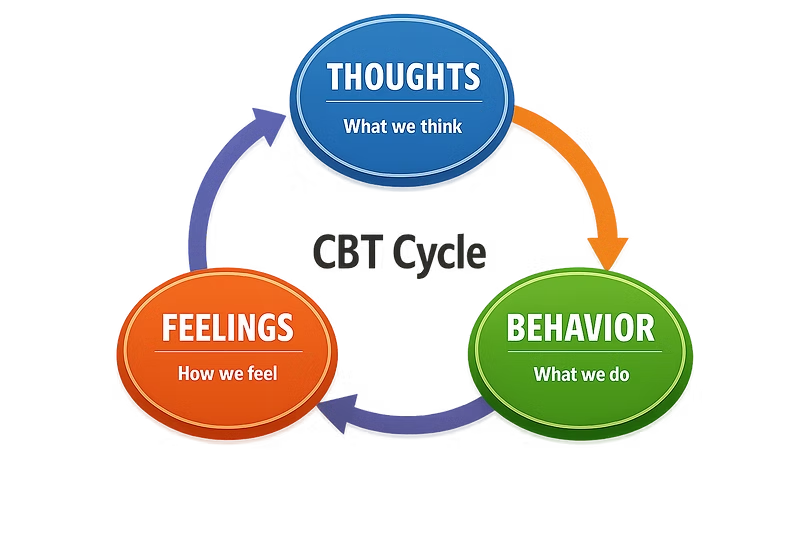
CBT is based on the belief that our thoughts cause our feelings, and our feelings influence our behavior. Have you ever been upset about something, and then when you thought about it, decided there was nothing you could do to control or change it, and then suddenly you felt much better? That is a simplified example of how CBT works.
Change one and the others tend to shift with it.
WHY WE DO NOT ALWAYS NOTICE OUR THOUGHTS
We all have unhelpful thoughts that cause us to feel upset and sometimes lead us to behave in an unhelpful way. The tricky part is that we are often unaware of them. After years of repetition, our reactions become so automatic that the thought itself slips beneath our awareness.
All we know is: something happened, and now I feel upset.
Over time, that hidden pattern can cause real trouble in work life, relationships, self-worth, and mental health. Strong feelings that seem to come out of nowhere often trace back to an automatic thought we did not catch.
CBT helps slow it down enough to see it.
WHAT CBT ACTUALLY DOES IN SESSION
CBT is not passive treatment. You are not simply talking about your week and hoping something shifts. In a CBT session, we work together to:
* Examine your way of thinking, both the thoughts you are aware of and the automatic ones running underneath.
* Assess whether those thoughts are helpful or accurate. Not every negative thought is wrong, and not every positive thought is right. The goal is accuracy, not forced positivity.
* Practice between sessions. Real change happens outside the therapy room. You apply what we discuss to real moments, notice what comes up, and we build from there in session.
* You leave therapy with tools, not just insight. Both matter, but tools are what you use on a Tuesday afternoon when the old pattern shows up again.
A SIMPLE EXAMPLE
Imagine you send a text to a friend, and they do not respond for a few hours.
Automatic thought: They are upset with me. I must have done something wrong.
Feeling: Anxious, guilty, maybe a little sad.
Behavior: You reread old messages. You draft an apology. You avoid your phone.
Now imagine the same situation with a different thought.
Thought: They are probably busy. I will hear back when I hear back.
Feeling: Mostly neutral. Behavior: You put the phone down and get on with your day.
Same event. Two different experiences. That is how thoughts, feelings, and behaviors influence one another, and that is exactly what CBT teaches you to work with.
WHO CBT CAN HELP
CBT has decades of research behind it and is considered a first-line treatment for many common concerns. In our Mesa, Arizona practice, we work with adults navigating:
* Anxiety and panic
* Social anxiety
* OCD
*Depression
* ADHD and the overwhelm that comes with it
* Low self-worth and a loud inner critic
* Stress and difficulty managing day-to-day demands
* Life transitions and identity shifts
* Academic and organizational struggles in college students
If something on this list sounds like you, you are not alone, and CBT can help.
WHAT CBT IS NOT
A few common misconceptions worth clearing up:
* CBT is not about ignoring your feelings. Emotions are information. We pay close attention to them.
* CBT is not forced positivity. The goal is accuracy, not optimism for its own sake.
* CBT is not a quick fix. Some people feel better within a few sessions. Others benefit from longer-term work.
* CBT is not the only tool. In my practice, I integrate Cognitive Behavioral Therapy with psychodynamic insight, because understanding why a pattern formed often matters as much as changing it.
HOW TO KNOW IF CBT MIGHT BE A FIT
Cognitive Behavioral Therapy is especially helpful if you:
* Get stuck replaying the same thoughts
* Notice a harsh inner critic
* Want practical tools and an active approach
* Appreciate structure and understanding the “why” behind what works
* Are willing to try small changes between sessions
* Insight is where change begins.
READY TO TAKE THE NEXT STEP?
We are a therapy practice in Mesa, Arizona. We work with adults navigating anxiety, social anxiety, depression, OCD, ADHD, low self-worth, and life transitions. We offer in-person sessions in Mesa and telehealth across Arizona for flexibility.
If you are curious whether Cognitive Behavioral Therapy, or therapy in general, might help with what you are going through, we would love to hear from you.